Say "soul food" and most people imagine a spread of barbecued ribs, fried chicken and pork chops, ham, black-eyed peas and green beans with ham hocks, corn bread, macaroni and cheese, potato salad, and a delectable list of desserts.
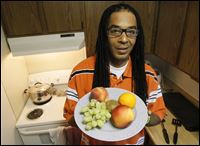
"That is not 'soul food,' " said Ishmael Shakur. Instead, to him, it is "destroying souls."
A vegetarian for six years, the 38-year-old who works with teenagers at the Zepf Center in Toledo gets upset when such a menu is labeled traditional African-American food.
"A lot of people think a real good, wholesome meal is when you sit back bloated and full and nod off," he said. "To me, soul food is food that adds to your spirit, gives you energy, gives you life, and helps you feel vibrant."
Mr. Shakur is among a rising number of black Americans who are becoming vegetarian and vegan, who eat a plant-based diet as well as grains, fruits, nuts, and seeds and exclude red meat, poultry, and seafood. There are several types of vegetarians: lacto vegetarians eat dairy products but not eggs; ovo vegetarians eat eggs but not dairy products; lacto-ovo vegetarians eat both eggs and dairy products, and vegans do not eat honey or any animal products whatsoever. Also, pescetarians eat seafood but no other flesh.
While there are no firm numbers, anecdotal evidence indicates a rising interest in vegetarianism and veganism among black Americans. In fact, their interest has contributed to the growing list of Internet sites and cookbooks geared to that group, including By Any Greens Necessary by Tracye Lynn McQuirter; Vegan Soul Kitchen: Fresh, Healthy, & Creative African American Cuisine by Bryant Terry, and The Ethnic Vegetarian by Angela Shelf Medearis.
There are many in the African American community that reject Western ideologies, speak of repatriation, and opine about how and why Black folks need to return to the motherland.
Ben Ammi Ben Israel actually did it.
In 1967, after receiving what he described as a prophetic vision, he helped organize the exodus of nearly 400 souls to Liberia, West Africa, where they would spend a two-and-one-half year “wilderness” period in conflict with the Liberian government while shedding what the community explained as “the many detrimental habits that as an enslaved people” they had acquired. In 1969, they continued their sojourn to Israel, where for over two decades they endured a lack citizenship status, work permits, access to schooling, health care, and the belligerence of an Israeli population unwilling to embrace a people who believed themselves to be descendants of the ancient Israelites. Over time, Ben Israel became recognized by his community as the Anointed Spiritual Leader of the African Hebrew Israelites, and after a sort of reconciliation with the Israeli government in 1990, the African Hebrew Israelites became a permanent fixture in the Israeli landscape, and from that time made great strides in education, organic agriculture, vegan food production and more.
Prince Immanuel Ben Yehuda, a member of the African Hebrew Israelite Holy Council said, “The insight, commitment, patience and compassion he [Ben-Israel] demonstrated was instrumental in leading us to forge a social model for humanity in which Yah might be pleased.”
Under Ben Israel’s leadership, the Hebrew Israelites have become renowned for their vibrant culture and boundless creativity. The holistic lifestyle of the community, coupled with high moral standards, was forged in keeping with their aim to fulfill the prophetic mandate of the Israelites to be “a light unto the nations.” Indeed, many of the ideas and standards that Ben Israel introduced to the community that were thought to be unusual at the time — including veganism, weekly fasting and the limiting of salt and sugar consumption — are now recognized as genius and have been implemented globally.
The community he founded has gained such popularity that an average of 500 visitors come to tour weekly the Village of Peace in Dimona, including political leaders from Israel, the U.S. and Africa. Other notables and celebrities drawn to Dimona include entertainers like Stevie Wonder, Kim Weston, the Neville Brothers, Ray Charles, Barry White, and of course, Whitney Houston, who adopted Ben Israel as her spiritual father.
In 1994, the U.S. Congress Human Rights Caucus proclaimed the Dimona community “The Miracle in the Desert” for its innovative and forward thinking structure and environment. In a 1994 feature article published in Teva Hadvareem, the community was feted as “An Island of Sanity.” The Israeli Ministry of Foreign Affairs in 2006 termed the accomplishments of the community a “phenomenon in a land full of phenomena.” Ben Israel guided the Hebrew Israelites through this most difficult period with untold perseverance and determination, resulting in the community earning permanent residency in 2003, with the granting of citizenship in a process that continues today. He was able to transcend the often contentious political and religious boundaries of Israeli that often confound the local scene by forging relationships based on integrity. In 2006, the community officially registered as an urban kibbutz, taking the name, “Guardians of Peace” (Shomrey HaShalom).
The Chicago community will celebrate the life of Ben Ammi Ben Israel on Saturday, Feb. 21, 2015, at the Legacy Chicago located behind Christ Universal Temple on 119th and Loomis. Interested parties should call 773.793.2547. To learn more about the African Hebrew Israelite community, click here.
We can fight off the sandman for a while, but after a certain point, sleeplessness leads to temporary madness and – just maybe – death, discovers Adam Hadhazy.
It’s surprising how we spend our lives. Reach your 78th birthday and according to some back-of-the-envelope calculations, you will have spent nine of those years watching television, four years driving a car, 92 days on the toilet, and 48 days having sex.
People start to hallucinate and go a bit crazy — Atul Malhotra, University of California
But when it comes to time-consuming activities, there’s one that sits head and shoulders above them all. Live to 78, and you may have spent around 25 years asleep. In an effort to claw back some of that time it’s reasonable to ask: how long can we stay awake – and what are the consequences of going without sleep?
Any healthy individual planning to find out through personal experimentation will find it tough going. "The drive to sleep is so strong it will supersede the drive to eat," says Erin Hanlon, an assistant professor at the University of Chicago's Sleep, Metabolism and Health Centre. "Your brain will just go to sleep, despite all of your conscious efforts to keep it at bay."
Why sleep at all? Exactly why the urge to sleep is so strong remains a mystery. "The exact function of sleep is still to be elucidated," says Hanlon. She adds, however, that there is something about sleep that seems to “reset” systems in our bodies. What’s more, studies have shown that routine, adequate sleep promotes healing, immune function, proper metabolism, and much more – which is maybe why it feels good to arise refreshed after a serious snooze.
(Getty Images)
On the flip side, insufficient slumber has been linked to greater risks of diabetes, heart issues, obesity, depression and other maladies. To avoid those latter outcomes, we are wracked with uncomfortable sensations when we burn the midnight oil: we lack energy, feel groggy, and find that our heavy eyelids press on aching eyes. As we continue to fight off sleep, our ability to concentrate and form short-term memories slackens.
If we ignore all these side effects and stay up for days on end, our minds become unhinged. We get moody, paranoid, and see things that aren’t really there. "People start to hallucinate and go a bit crazy," says Atul Malhotra, the Director of Sleep Medicine at the University of California, San Diego. (Long-haul truckers have an evocative term for this hallucinatory phenomenon: "seeing the black dog". When a shadowy apparition appears on the roadway, so the advice goes, it's time to pull the lorry over.)
Many studies have documented the body's parallel decline during sleep deprivation. Stress hormones such as adrenaline and cortisol increase in the blood, in turn elevating blood pressure. Meanwhile, heart rhythms get out of whack and the immune system falters, says Malhotra. Sleep-deprived people accordingly feel anxious and are likelier to come down with an illness.
(Getty Images)
Still, all the havoc wreaked by a bout of insomnia or a few all-nighters does not seem permanent, disappearing after solid shuteye. "If there's any damage, it's reversible," says Jerome Siegel, a professor at the Centre for Sleep Research at the University of California, Los Angeles.
When the curtain never falls But what if sleep never can come? A rare genetic disease called Fatal Familial Insomnia provides one of the starkest pictures of the consequences of extreme sleeplessness.
Only about 40 families worldwide have FFI in their gene pools. A single defective gene causes proteins in the nervous system to misfold into "prions" that lose their normal functionality. "Prions are funny-shaped proteins that screw these people up," says Malhotra. The prions clump in neural tissue, killing it and forming Swiss cheese-like holes in the brain (which is exactly what happens in the best-known human prion disorder, Creutzfeldt-Jakob disease). One area that is particularly badly affected in people with FFI is the thalamus, a deep brain region that controls sleep. Hence the debilitating insomnia.
An afflicted individual suddenly goes days on end without rest and develops weird symptoms such as pinpoint pupils and drenching sweats. After a few weeks, the FFI victim slips into a sort of pre-sleep twilight. He or she appears to be sleepwalking and exhibits those jerky, involuntary muscle movements we sometimes have when falling asleep. Weight loss and dementia follow, and eventually, death.
(Getty Images)
Still, sleeplessness per se is not thought to be the lethal agent, because FFI leads to widespread brain damage. "I don't think it is sleep loss that kills these individuals," says Siegel. Similarly, the oft-used torture tactic of depriving human prisoners of sleep is not known to have summarily caused anyone to die (although they will still suffer horribly).
Along these lines, animal sleep deprivation experiments provide more evidence that a lack of sleep in its own right might not be deadly, but what prompts it may well be.
Studies by Allan Rechtschaffen at the University of Chicago in the 1980s involved placing rats on discs above a tray of water. Whenever the rat tried dozing off, as revealed by changes in measured brain waves, the disc would rotate and a wall would shove the rat towards the water, startling it back awake.
All rats died after about a month of this treatment, though for unclear reasons. Most likely, it was the stress of being awoken – on average a "thousand times a day" says Siegel – that did the rats in, wearing down their bodily systems. Among other symptoms, the rats exhibited body temperature dysregulation and lost weight despite an increased appetite.
(Getty Images)
"That’s the problem in interpreting sleep studies in humans and animals: You can't thoroughly deprive a person or an animal of sleep without their cooperation and not impose a fair amount of stress," says Siegel. If death occurs, "the question is, 'is it the stress or the sleep loss?' It's not an easy distinction."
Wake up! Wake up! All of this may well put most people off exploring the limits of our capacity to go without sleep, but the question remains: how long can we stay awake? The most widely cited record for voluntarily staving off sleep belongs to Randy Gardner, at the time a 17-year-old high school student in San Diego, California. For a science fair project in 1964, Gardner did not hit the hay for 264 hours straight, or just over 11 days, according to scientists who monitored him towards the end of his vigil. Numerous other, less credible accounts abound, including one of a British woman in 1977 who won a competition to continuously rock in a rocking chair (presumably by a landslide) by doing so for 18 days.
Overall, the jury is out on just how long a human could ever stay awake, but perhaps that's a good thing. Acknowledging the injury people might cause to themselves through intentional sleep deprivation, the Guinness Book of Records stopped keeping track of this particular superlative last decade.
A Celebration of Our Appreciation
by WOV Tovleeyah E. Ahtur Keymah
KNN-Atlanta
The Distinguished Orders of the Men and Women of Valor of the Atlanta Jurisdiction cordially invite you to attend our Yom L'Mokereem (Day of Appreciation) celebration, March 2, 2013, from 9pm until, at the Return to Royalty Banquet Hall at 879 Ralph David Abernathy Blvd., Atlanta, GA.
This year's theme "Rooted in Wholeness, Oneness & Unity: A Celebration of Our Appreciation" conveys our collective experience up to this point. As one whole unit, we have overcome because we are rooted, committed and have remained steadfast. We trust in Yah, and we anxiously anticipate the unfoldment of the next phase of the vision.
It is in this season that we recognize and celebrate our gratitude for Yah's blessings and His divine revelations He bestows upon us, our extraordinary visionary leaders, wonderful families, cherished loved ones and beloved friends. This is the time we make special effort to honor those we appreciate in our lives.
Come out and enjoy an evening in divinity, live and DJ'd music, good food! (did I mention the food will be good?). You would not want to miss out on this! The colors are royal purple, turquoise and metallic gold accents.
Tickets are $30 in advance (prior to Feb 23), and $35 from until the event. The cuisine will be exquisite. Please specify upon purchasing your ticket whether you will be eating cooked or "live" foods that evening. To get your tickets, please call 404.752.5194.
Back
by popular demand:
Sugarless & Live Foods Weeks
KNN-Village of Peace
Dimona, Israel
In its continual ascension into the higher realms in pursuit
of perfect health and Everlasting Life, the African Hebrew Israelite
Community's Ministry of Divine Health at Dimona, Israel directs and regulates Sugarless
and Live (raw) Foods consumption Weeks.
This quarterly cycle of cleansing
and rejuvenation was created by and for the Community, and has been practiced
by it members worldwide for several years. It is a viable, health-enhancing
lifestyle adddition for anyone in pursuit of excellent health, a more vibrant
life, more abundant strength, energy and longevity than what is enjoyed prior
to engaging it.
For ample preparation time to put in place necessary procedures and items
relative to this cycle such as maple
syrup, colon cleanser, schedule colonics/colemas, ionic foot baths,
etcetera, prior to the upcoming seasonal cycle, please make a note of the
following dates:
7 December, 2012-Sugarless Week will begin at sunset on Yom Sheshe (Friday).
15 December, 2012-Sugarless Week will end on Mohtsai Shabbaht (Saturday at sunset).
15 December, 2012-Live Week will begin on Mohtsai Shabbaht (Saturday at sunset).
21 December, 2012-Live Week will end on Yom Sheshe (Friday) at sunset.
To date, the manifold benefits and blessings of Sugarless and Live Foods Weeks
have been appreciated worldwide by thousands of Community members and
non-members alike. Each season, these individuals reap its delicious fruits and
bear precious personal testimonies of health success towards the attainment and
maintenence of optimal health.
The results of the standard, curative, global health model have been well noted.
Alternatively, through conscienscious application of any of the Community's
tried and proven health-enhancing lifestyle practices as a safeguard in the
prevention of dis-ease, some of its preventive health model's benefits include
decreases in:
frequency of hospital, doctor and pharmacy vists,
dependency on high-cost, high-risk medical interventions,
occurrences of unpaid leave and "sick days" off of
work due to illness.
The healthy lifestyle adjustments touts increases in:
weight loss,
intestinal (bowel) regularity,
overall greater sense of well-being,
ability to think/reason more clearly,
ability to achieve a more sound sleep,
greater relief from pre-existing ailments,
sense of empowerment, control of and responsibility for
one's own health,
greater financial freedom (more time at work earning full
salary due to better health).
To learn more about Sugarless and Live Foods consumption weeks, please click here.
Otherwise, simply stay tuned to KNN for seasonal Sugarless and Live Foods Week
updates.
For holistic health-related inquiries, The Ministry of Divine Health may be
contacted at divine.healers@yahoo.com
"We are encouraging all to utilize this special cycle of Sugarless and
Live Foods Weeks to prepare the Adamic mind/soul/body complex for the physical
and spiritual elevation of THE NEW MAN."
-Ministry of Divine Health
(www.Natural-Culture.com) is the largest on-line shopping website for high-quality products created, sold or used by the African Hebrew Israelites of Jerusalem; a 40-year young community praised globally for their expertise on health, organic agriculture, social stability, and clean living. Located on the urban kibbutz Shomrey HaShalom ("The Peace Keepers") in Dimona, Israel; this community produces ecologically-friendly, health-oriented and cultural products. On-line sales items include handcrafted jewelry, African Edenic art prints, health and spiritual e-books, positive music, modest clothing and beautiful clothing accessories.
"We want you to have the best on-line shopping experience that we can give," says
Sister HYPERLINK "http://www.natural-culture.com/article/who-is-sister-zakhah/"Zakhah, founder of the Natural Culture website, divine entrepreneur, and former Sales and Marketing Director of the Washington, DC-based Communicators Press on-line book company. We respond to product and service-related questions within 24 hours. Our customer support team has over 10 years of on-line selling experience and really listen to our customers. We offer low to no shipping costs, a friendly returns policy, and detailed product information."
OUR PRODUCTS
Positive sounds from the digital music collection upload to your laptop, desktop, iPod, iPhone, or iPad. Genres include R&B, Neo-Soul, Reggae, Gospel, Hip Hop and our exclusive Sounds of Deliverance. Watch beautiful music videos and hear inspiring song samples before you buy.
E-books on nutrition, relationships, spirituality, history, and children
can be downloaded instantly. Titles such asThe Sacred Diet: Nutritional Guidelines, Natural Pregnancy & Divine Childbirth and Immortality will open your mind to new possibilities life has to offer. Get instant access to the writings of Ben Ammi, the spiritual leader of the African Hebrew Israelites of Jerusalem.
Not sure if you are pronouncing Hebrew prayers correctly? The Prayers from Jerusalemaudio books will help you stay on point.
Our high-quality mail-order items are great for your lifestyle and make wonderful gifts. Colorful African Art prints are perfect for you home or office. Each of our signature hand-crafted jewelry pieces are created by our professional artisans. Their collections have been displayed by celebrities, athletes, models, museums, and major department stores all over the world. Each piece is formed from precious healing crystals, stones and metals.
You can guarantee that each one of our uniquely designed clothing items and accessories are made with all-natural materials and tailored to your specifications. From our cultural trademark Cords of Blue to the knitted and crocheted head-coverings, keepote and kovaeem, and eco-shoes, to our highly sought-after Cignon Garden of Style tailor-made modest clothing line. All of which will be featured in Autumn 2012. Sign up for our Natural Culture newsletter to be alerted when they are available. You will also receive other product alerts, articles and discounts.
ARTICLES
Here at Natural Culture, we like to keep things fresh and exciting. We work hard to add new products to our site almost every week. We feature information about our products to highlight why they are distinctively designed for your healthy, busy, God/Yah-centered, on-the-go, hard-working, royal, truth-based lifestyle. If you have any specific request for products, let us know by emailing: NaturalCulture777@gmail.com.
DONATIONS
Natural Culture accepts monetary donations for the many humanitarian projects sponsored by the African Hebrew Development Agency (AHDA) . Upwards of 85% of your donation to AHDA goes towards projects that improve health, family and social conditions of people globally in underdeveloped countries. Here are just a few examples of where your donations have greatly assisted with our projects:
The drilling of more than 20 boreholes in West Africa and at an
all-girls boarding school in Kenya. The boreholes have increased school attendance by reducing sick-days from waterborne diseases from dirty well water;
Sponsorship for top academic students from Akvah Community School in Israel to receive scholarships to universities. Recently, our students obtained some of the highest standardized test scores in the entire country. Funding for academic programs will assist our students with continuous academic excellence;
Organic agriculture programs and true green businesses being formed in Sub-Sahara Africa. Local farmers have been able to re-establish their livelihoods and adequately support their families again despite the sinister pushing of pesticide-laden GMO foods on the global community;
Exploration for alternative energy sources for indigenous people so they may increase their quality of life. For example, solar cooking has not only
Please continue to show your support so that we can affect positive change in the lives of people all around the world. To donate now, please click here
CONTACT US
Join our mailing list today to receive monthly product alerts, articles and discounts from
www.Natural-Culture.com For purchases, we accept Paypal and most major credit cards.For more information, questions, comments, suggestions, or just to holla, email NaturalCulture777@gmail.com.
The Wave OfferingSubmitted by Ahkote Taahmeenyah E. Sar Elyahshuv - Lamdahneet HaTorah Student of the LawKNN Dimona וַיְדַבֵּר
יְהוָה, אֶל-מֹשֶׁה לֵּאמֹר. דַּבֵּר
אֶל-בְּנֵי יִשְׂרָאֵל, וְאָמַרְתָּ אֲלֵהֶם, כִּי-תָבֹאוּ אֶל-הָאָרֶץ אֲשֶׁר
אֲנִי נֹתֵן לָכֶם, וּקְצַרְתֶּם אֶת-קְצִירָהּ--וַהֲבֵאתֶם אֶת-עֹמֶר
רֵאשִׁית קְצִירְכֶם, אֶל-הַכֹּהֵן. וְהֵנִיף
אֶת-הָעֹמֶר לִפְנֵי יְהוָה, לִרְצֹנְכֶם; מִמָּחֳרַת, הַשַּׁבָּת,
יְנִיפֶנּוּ, הַכֹּהֵן.
וַיִּקְרָא 23:9-11
And
the Lord spake unto Moses, saying, Speak
unto the children of Israel, and say unto them, When ye be come into the land
which I give unto you, and shall reap the harvest thereof, then ye shall bring
a sheaf of the firstfruits of your harvest unto the priest: And
he shall wave the sheaf before the Lord, to be accepted for you: on the
morrow after the sabbath the priest shall wave it.
Leviticus 23:9-11
Let us pay close
attention to verse 11. This scriptural reference states that “on the morrow
(next day) after the Sabbath, the priest shall wave it.” This wave offering
process comes from the Hebrew term “תנופה” (ti-noo-fah):
Sheaf of the waving – (oh-mehr ha-ti-noo-fah)–עומר התנופה
Whenever an omer was brought as an offering to the
Priesthood, they would wave it on the day after the Sabbath (ממחרת השבת).The wave offering would always take place on
the first day of the week (Yom Reshone)/יום ראשון), which was the day after the
Sabbath. We can understand this established order if we look closer into the
cultural patterns of the biblical Hebrew Israelites.
Read more….get your copy of
the booklet “Towards a Better Understanding: The Counting of the Omer
Shavuote” by The Prophetic Priesthood at Jerusalem (thepropheticpriesthood@yahoo.com)
The cultivation
of land areas in the community of the African Hebrew Israelites in Dimona,
Israel–Northeast Africa (“The Village of Peace”) began in 1980. Prince
Eleazer, Prince Eliahv, Prince Rockameem and others of like agrarian spirit
tilled the soil developing organic vegetable gardens throughout the four
corners of the village.Brother Yehuda,
husband of Sister Tifoosah and Sister Meirah was among the core vanguard of Divine
soil stewards that caused the soils of the Village gardens to yield nutritional
strength to the souls of the community’s members, providing greens and other
organic vegetables.
The
2012 Ceremony of the Wave Offering was very special testifying of the ascension
of organic agriculture paved by the extraordinary leadership of Minister Yadiel
(Minister of Divine Agriculture). After years of going into other people’s
fields to get sheafs of wheat for our wave offerings, in preparation for this
year’s offering we grew our own wheat! Sister
Tifoosah, answering the invitation of Brother Aylenaton and Brother Nathaniel
to utilize Brother Yehuda’s Field of Glory, they were able to plant wheat to be
harvested at this year’s wave offering for the first time. Chosen First Fruit Boaz
was chosen to bless the Field of Glory with a prayer after which we were able
to offer up our own wheat sheafs for the wave offering. Brother Yehuda is
represented in the photo by his wife Tifoosah and grandson Yehuda Kiel (son of
Bother Yishikai and Yovellah). Greens from the Community Farmlands (HaKavah), bee
pollen (in jar) from our very own beehives and our 100% Pure Holy Land Olive
Oil (cold pressed) were presented as well.